from 0 review
Daily Tour
1 person
English, Francais
If you’re planning your first trip to India, a Golden Triangle tour with Varanasi is one of the most complete ways to experience the country in a single journey. This 7-night, 8-day itinerary brings together the three iconic cities of Delhi, Jaipur, and Agra — collectively known as the Golden Triangle — with an extension to Varanasi, one of the oldest continuously inhabited cities in the world and the spiritual heart of India.
A typical Golden Triangle tour with Varanasi begins in Delhi, where you’ll explore Mughal-era landmarks like the Red Fort and Jama Masjid, walk through the chaotic lanes of Chandni Chowk on a rickshaw, and visit modern icons such as the Akshardham Temple and India Gate.
From there, the route moves to Jaipur, the Pink City, known for the Amber Fort, City Palace, and Hawa Mahal, before continuing to Agra to witness the Taj Mahal and Agra Fort — arguably the highlight of any Golden Triangle tour with Varanasi included on the itinerary. What sets this route apart from the standard three-city circuit is the addition of Varanasi, reached by an overnight train from Agra.
Here, travelers walk through the narrow alleyways of old Banaras, take a sunrise boat ride along the Ganges, and witness the mesmerizing Ganga Aarti ceremony at Dashashwamedh Ghat — an experience that adds a deeply spiritual dimension to an otherwise historical and architectural journey. Because it blends Mughal history, royal Rajasthani heritage, and Hindu spiritual tradition in one trip, a Golden Triangle tour with Varanasi consistently ranks among the most sought-after itineraries for first-time visitors to India, offering a far richer picture of the country than the Golden Triangle alone.
Delhi, India’s capital, is served by Indira Gandhi International Airport in the Palam area of South West Delhi — both international and domestic flights arrive here. Your driver (and guide, on request) will meet you at the airport and transfer you to your hotel.
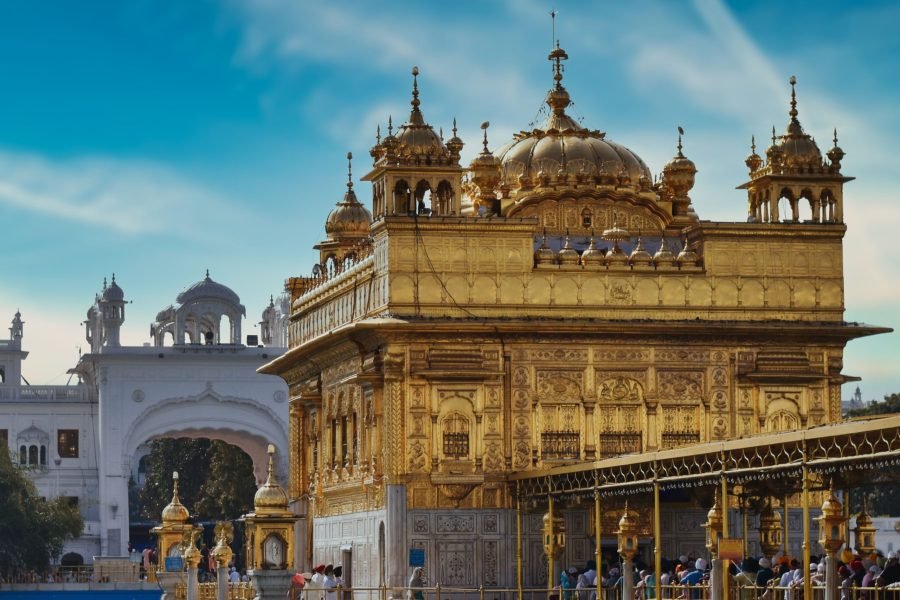
After check-in, begin sightseeing with Bangla Sahib Gurudwara, a Sikh house of worship built by Sardar Baghel Singh in 1783 AD. Visitors must cover their heads; scarves are provided if needed. The Gurudwara runs a huge free community kitchen (langar) feeding thousands daily.
Next, visit the Jama Masjid, one of India’s largest mosques, commissioned by Mughal emperor Shah Jahan (son of Jahangir) around 1644 AD. Modest dress is required and is provided on site if needed.
End the day with a rickshaw ride through Chandni Chowk, Old Delhi’s chaotic and colorful market district, followed by a stop at the Red Fort, built by Shah Jahan starting in 1628 AD. Return to your hotel for the night.
Pickup around 10 AM (confirm timing with your guide). Visit India Gate, a war memorial honoring 74,187 Indian Army soldiers who died in WWI (1914–1921) across France, Persia, and beyond — a popular photo spot.
Continue to the Lotus Temple (Bahá’í House of Worship, opened 1986), then the Qutub Minar, a UNESCO World Heritage minaret founded by the Tomar Rajputs in 1220 AD, and Humayun’s Tomb, built in 1558 AD.
Finish at the Swaminarayan Akshardham Temple (completed 2005) — the evening water show is highly recommended. Transfer back to your hotel.
Depart for Jaipur by car or train early in the day (flights available on request). On arrival, your driver transfers you to your hotel for check-in and rest before sightseeing begins.
Visit the Albert Hall Museum, one of India’s oldest museums (established 1887), home to a collection of jewelry, carpets, and paintings. Continue to Jaigarh Fort (built 1726) and Nahargarh Fort (built 1734). Return to the hotel to rest.
Begin at the hilltop Amber Fort (built 1526) — its intricate artistry is worth 2–3 unhurried hours. Then explore Jaipur’s other treasures: the City Palace, the delicate Hawa Mahal, and Jantar Mantar’s giant astronomical instruments. Stop by Jal Mahal’s lake palace, Krishna Meera Temple, and the stepwell at Panna Meena Kund. End the day at Hathi Gaon with an elephant ride. Transfer back to your hotel.
Early departure from Jaipur to Agra by train (car or flight available on request). Visit the Taj Mahal (built 1631 by Shah Jahan for Mumtaz Mahal) and Agra Fort (renovated by Akbar in 1573).
After a meal, board an overnight AC train to Varanasi, departing around 6 PM and arriving the next morning around 6 AM (roughly a 13-hour journey).
On arrival at Varanasi Railway Station, your driver transfers you to your hotel.
After freshening up, set out with your guide on a walking tour through old Banaras’s narrow galis. Pass flower markets and bustling bazaars along the way. You’ll also see the ghats, including Manikarnika Ghat — a cremation ground active around the clock.
In the evening, witness the Ganga Aarti at Dashashwamedh Ghat. It’s held around 7 PM in summer and 6 PM in winter, depending on sunset.
Return to your hotel.
An early 5 AM start for the sunrise boat ride on the Ganges.
Cars can’t reach the riverbank directly, so your guide walks you down. From there, board a private boat to take in the ghats at sunrise.
After breakfast, visit Kashi Vishwanath Temple, one of India’s twelve Jyotirlinga shrines dedicated to Lord Shiva. Next is Sarnath, where Buddha delivered his first sermon. Round out the day with Sankat Mochan Hanuman Temple (Monkey Temple), Tulsi Manas Temple, and Durga Temple. Then return to your hotel.
Travel to Delhi by early morning train (around 6 AM, 8–12 hours) or by flight (about 90 minutes) — let your operator know your preference. Arrive in Delhi to continue to your next destination.

Member Since 2026


Leave a review